
Castinera
The operating system of casting in Mexico
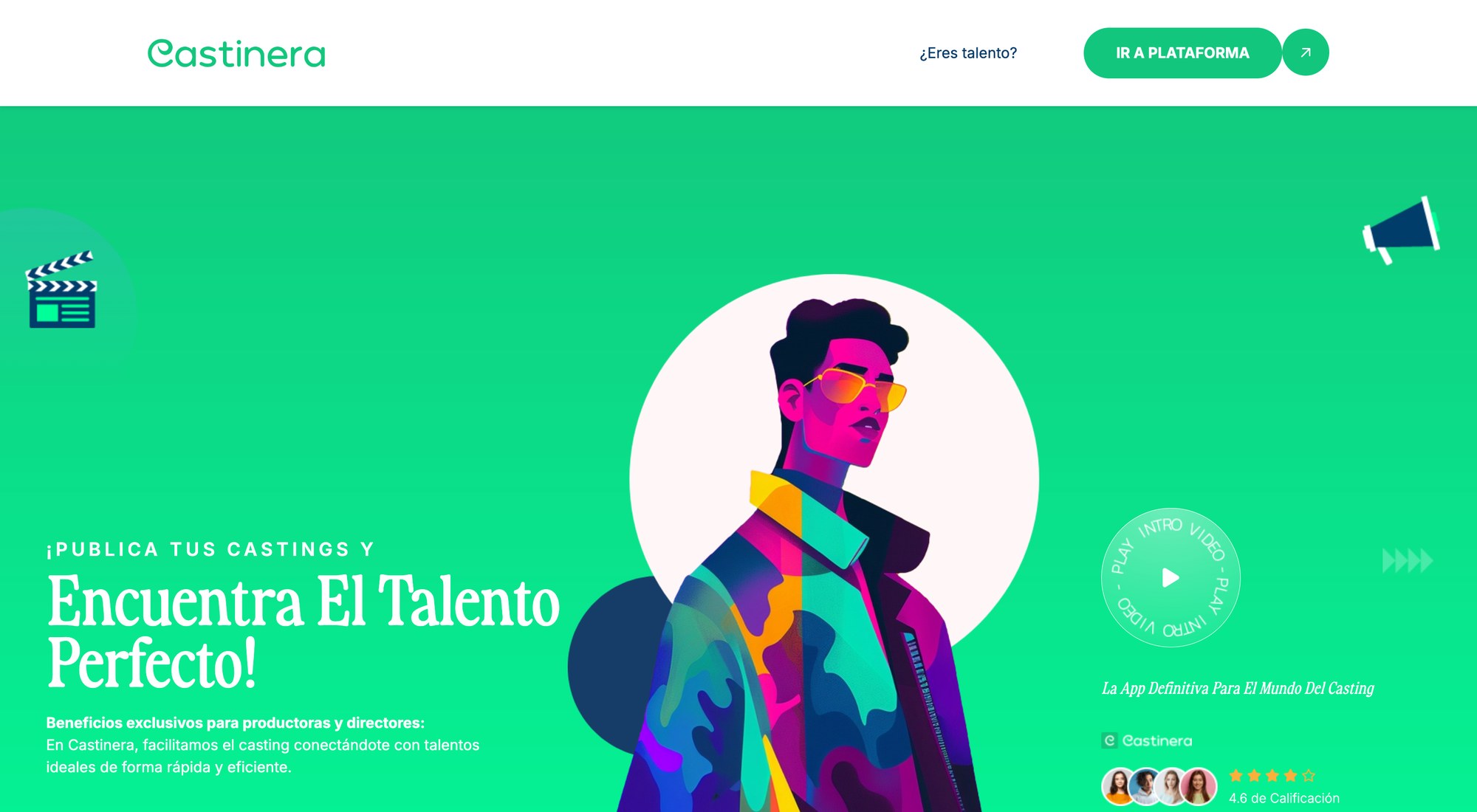
Castinera is the platform where casting in Mexico stopped living in WhatsApp, email and Drive folders. Talent, talent agencies, casting agencies and production houses each enter through their own door into the same record. Two and a half years on: 7,441 talent profiles, 496 companies and a process that can finally be measured.
The problem was never the talent
Mexico has a large audiovisual industry and no shortage of talent. What it didn't have was a place where the process actually happened.
Casting was handled — and largely still is — over WhatsApp, email and Drive folders. A casting director sent the call to three group chats, received two hundred videos over messaging, downloaded them by hand, assembled a PDF in Keynote and emailed it to the client. The talent agency submitted its actors separately, with no way of knowing they arrived. The actor sent the same self-tape twenty times to twenty contacts and never learned whether anyone opened it.
Everyone operated on their own copy of the truth. None of the copies talked to each other.
- There was no record. Every casting started from zero. A production house couldn't find the talent it liked six months ago, couldn't know who it had already invited, couldn't compare two calls against each other.
- Video is heavy. A phone-shot self-tape runs 80 MB to 2 GB. Neither WhatsApp nor email moves that without destroying it. The material that decides a hire arrived compressed past the point where the performance could be judged.
- The agent was left out. Talent agencies make their living managing represented actors, but digital tools treated them as if they didn't exist: either the actor signed up alone and the agency lost visibility, or the agency sent PDFs and the actor was kept in the dark.
- Nobody measured. How many days does a casting take to close? What share of invitees respond? How many applications do you need to fill a role? Nobody in the industry had that number, because the system capable of producing it didn't exist.
Four roles, one record
The decision that defines this project: we didn't build an app for actors or a dashboard for producers. We modeled the entire industry and gave each role its own way into the same data.
Talent get an account, a profile and a portfolio — photos, self-tapes, credits, training, measurements, languages and skills. They apply, see who viewed their profile, receive callbacks and talk to production inside the platform. 7,012 actors manage their own account.
The agent isn't left out. Agencies manage their roster inside the platform: they register represented talent, maintain their material, submit them and watch them move through the funnel — without losing the client relationship and without cutting the actor off from their own access. 52 companies operate a roster of 675 managed talent, and 238 distinct agencies are named by talent across their profiles.
The casting director carries the heaviest load. They publish calls, search the full roster by physical attributes, skills, location, age and agency; invite directly, shortlist, schedule callbacks and deliver to the client. 15 casting agencies published 320 of the platform's 584 calls — more than half of total volume.
The production house enters from the top: creates the project, defines the roles, tracks each call's progress and receives the final cut. It can publish directly or delegate to a casting agency, and either way the project lives in the same place. 230 registered production houses.
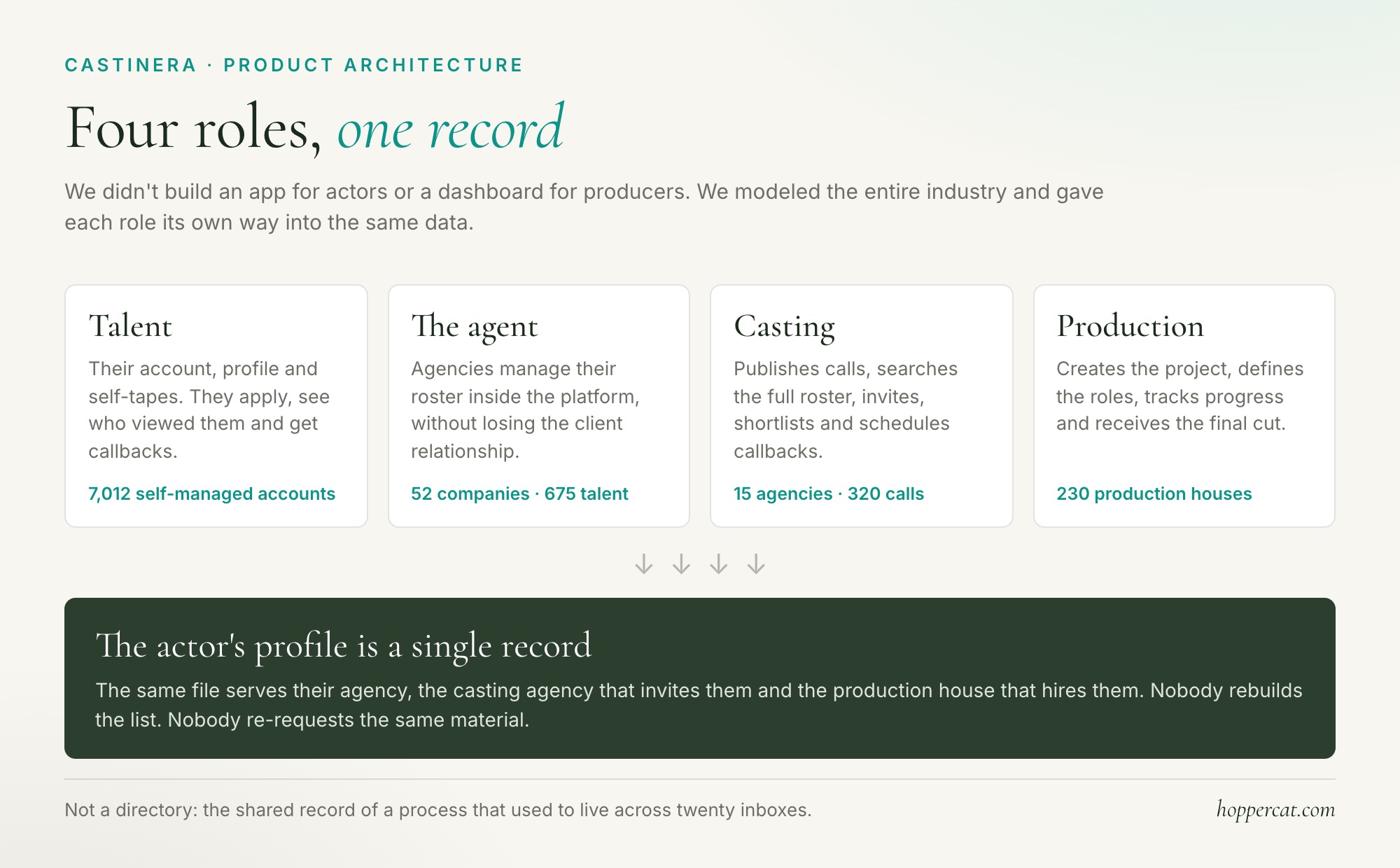
The point isn't the four roles. The point is that the actor's profile is a single record. The same file serves their agency, the casting agency that invites them and the production house that hires them. Nobody rebuilds the list. Nobody re-requests the same material. The actor updates their reel once and it's updated for the whole industry.
That's what we consolidated: not a directory, but the shared record of a process that used to live across twenty separate inboxes.
How we approached it
1 · Diagnosis. We mapped a casting director's real workflow across a full production, from client brief to final PDF. That surfaced the finding that ordered everything else: the bottleneck wasn't finding talent, it was handling video and keeping one live record across producer, agency and actor.
2 · Data model first. Before a single screen we modeled the domain: project → call → invitation → application → shortlist → callback → selection, with company, talent and agency as first-class entities. That model is why analytics, chat and automation could later be built without rewriting anything.
3 · Execution across three surfaces. Mobile app for talent (iOS + Android), web dashboard for producers and casting, and a talent web portal at feature parity. One backend, one model, three clients.
4 · Measurement from the inside. We didn't instrument "the website" — we instrumented the process. Hiring funnel, time-to-fill, invitation response rate and profile views are product endpoints, not tag-manager events.
5 · Continuous optimization. Two and a half years of iterating on real data: which filters casting agencies actually use, where talent drops off, which video format fails on which device.
What we built
| Area | What it solves |
|---|---|
| Casting engine | Status management with automatic expiry closing, invitations with per-plan limits, callbacks with confirmation and attendance, and PDF generation for applications with headshot and stats |
| Two-way email | The producer replies from their usual inbox and the thread stays inside the platform |
| Two domains, one build | proyectos.castinera.com for producers and casting, app.castinera.com for talent, resolved server-side |
| Roster search | Filters by physical attributes, 131 skills across 11 categories, location, age and agency |
| Mobile app | iOS and Android at feature parity, chat with unread badges, self-tape upload from gallery and iCloud |
| Product analytics | Hiring funnel, invitations, callbacks and revenue for the producer; applications, upcoming callbacks and profile views for talent |
| AI intake | The producer sends the brief exactly as they have it — a WhatsApp message or a photo — and the system turns it into a structured call with roles, age ranges, shooting dates and payment |
| WhatsApp bot | Because the industry still lives there, and denying it doesn't move it |
All on a single backend with 30+ content types, continuous deployment to production and error monitoring across all three surfaces.
The self-tape
If one technical decision defines this project, it's having treated video as the product rather than as an attachment.
The first version did what everyone does: upload the file to the server, process it, send it to storage. With 200 MB videos shot on a phone in a house with 3 Mbps wifi, that meant twenty-minute uploads that failed at minute eighteen and left no trace. The actor didn't know it had failed. The producer never knew that actor existed.
We rebuilt it end to end. Direct device-to-storage upload, a real progress bar, tolerance up to 2 GB, specific handling for videos that live in iCloud rather than on the device, and — when a producer deletes a self-tape to request another take — the ability to re-upload from app or web without opening a new application.
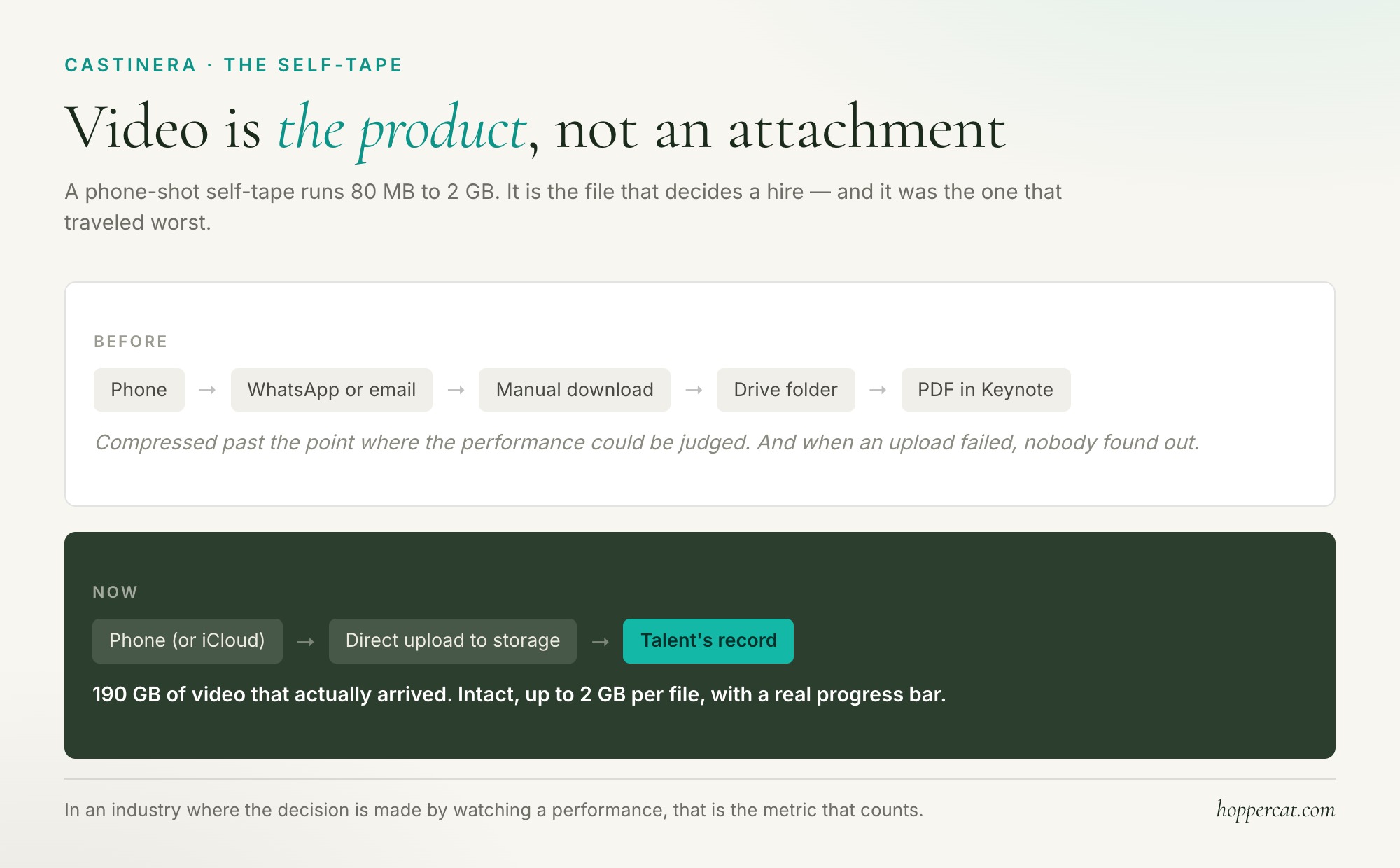
The result is 190 GB of video that actually arrived. In an industry where the decision is made by watching a performance, that's the metric that counts.
The results
Verified in production as of July 27, 2026, on work running since January 2024.
The roster. 7,441 talent profiles and 8,342 registered accounts. 2,683 actors have applied at least once. 732 declare representation by 238 distinct agencies and 335 declare a union — 326 of them ANDA: this is not a hobbyist roster, it's professional talent with guild structure.
The industry, connected. 496 companies: 230 production houses, 80 talent agencies and 71 casting agencies. 113 have created at least one project and 85 have published at least one call. The most active accumulates 250 calls and 2,299 applications inside the platform.
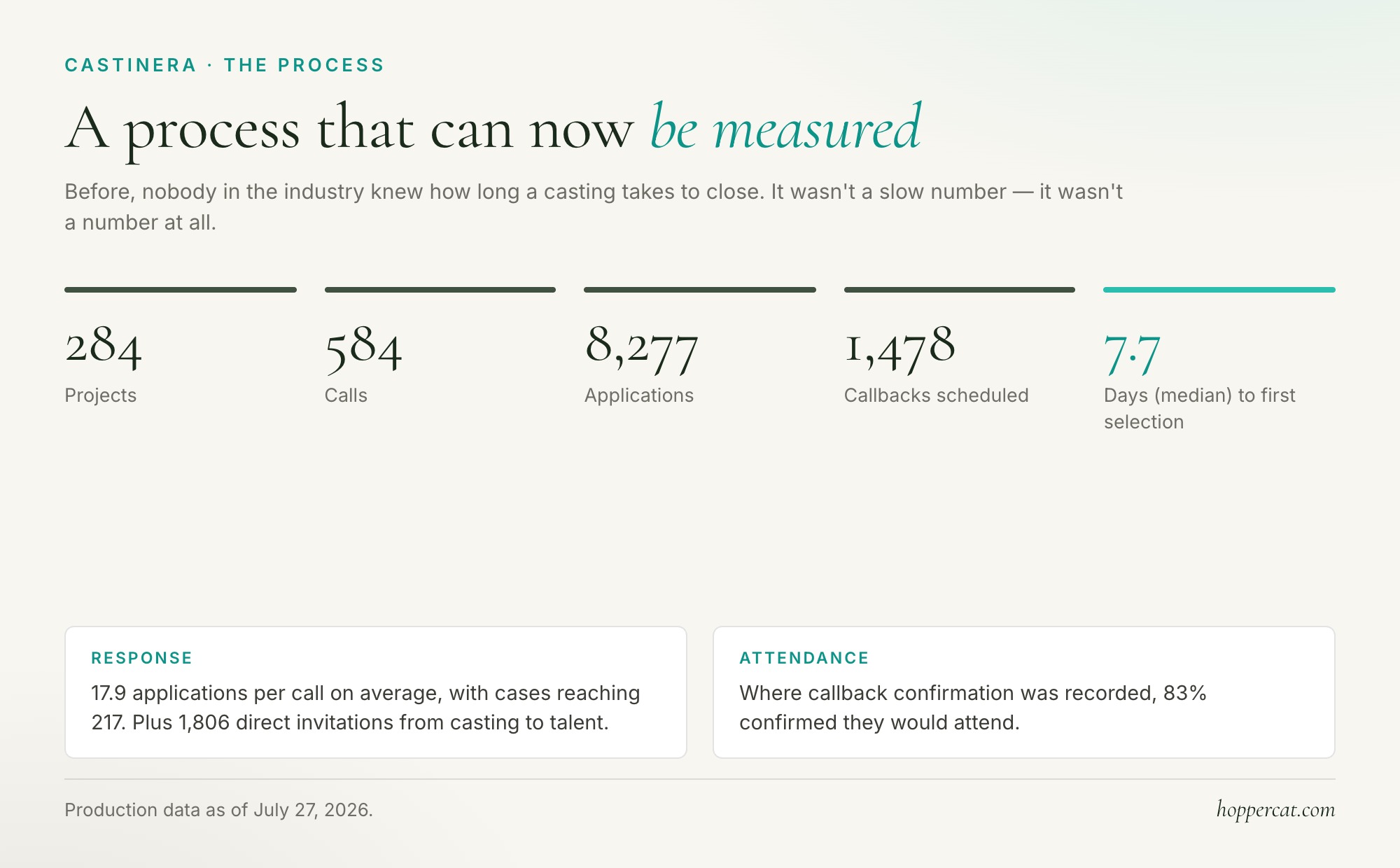
The process. 284 projects, 584 calls, 8,277 applications, 1,806 direct invitations and 1,478 scheduled callbacks. An average of 17.9 applications per call, with cases reaching 217. Where callback confirmation was recorded, 83% confirmed attendance.
The speed. From open call to first selection: a median of 7.7 days. That number is the cleanest before-and-after in the project, because before it wasn't a slow number — it wasn't a number at all.
The archive. 47,197 files and 198 GB. 4,799 videos — 190 GB — and 42,286 photographs. An indexed, searchable audiovisual archive of Mexican talent that existed nowhere else.
The product in users' hands. 4.7 ★ on the App Store (132 ratings) and 4.7 ★ on Google Play (150 ratings), with 5,000+ Android downloads. For a niche professional tool, a sustained rating like that is the most honest indicator that the workflow works.
The digital footprint. 6,450 web users across 67 countries. Mexico accounts for 63%, followed by the United States, Argentina, Spain, Chile and Colombia — the same map Spanish-speaking talent follows. On Meta, 3.17M impressions and 2.19M people reached on 15,086 MXN of total spend: a 4.76 MXN CPM and 313K video views at 4.8 centavos each.
What this case doesn't measure
The figures above record what happened inside the platform, and there are things that record doesn't capture.
First: platform volume is a direct function of investment in marketing and operations. While both were active, the roster and the calls grew; when they were paused, growth paused with them. That's not a product ceiling — it's the expected result of switching acquisition off.
Second: the commercial value of the projects resolved here is far larger than what the platform's own billing rails record. The production houses and casting agencies working in Castinera hire real advertising and audiovisual production, with budgets settled outside the system. The digital transaction is the young part of the story; the work the platform coordinated is not.
And a third, for honesty's sake: Castinera did not replace WhatsApp. The industry still largely operates over messaging, and the platform coexists with that habit rather than denying it — which is exactly why the WhatsApp bot and the text-and-image call ingestion exist.
What this means for your business
Castinera isn't a casting app. It's a multi-sided marketplace with a heavy workflow, high-weight files, a multi-stage funnel and intermediaries you can't design away. If your industry has suppliers, intermediaries and buyers who coordinate today over messaging and spreadsheets, the pattern transfers almost whole.
What was built here and gets reused: marketplace architecture with asymmetric roles sharing a single record, direct-to-storage upload for files that break a web server's limits, instrumented funnels that produce real business metrics, natural-language intake so users don't fill out forms, and one backend serving mobile and web without duplicating logic.
Ready for a diagnosis?
Enter your name, website and email or WhatsApp. We check 42 points on your business and send you a written report, usually in under an hour. No call required.
Get your free diagnosis